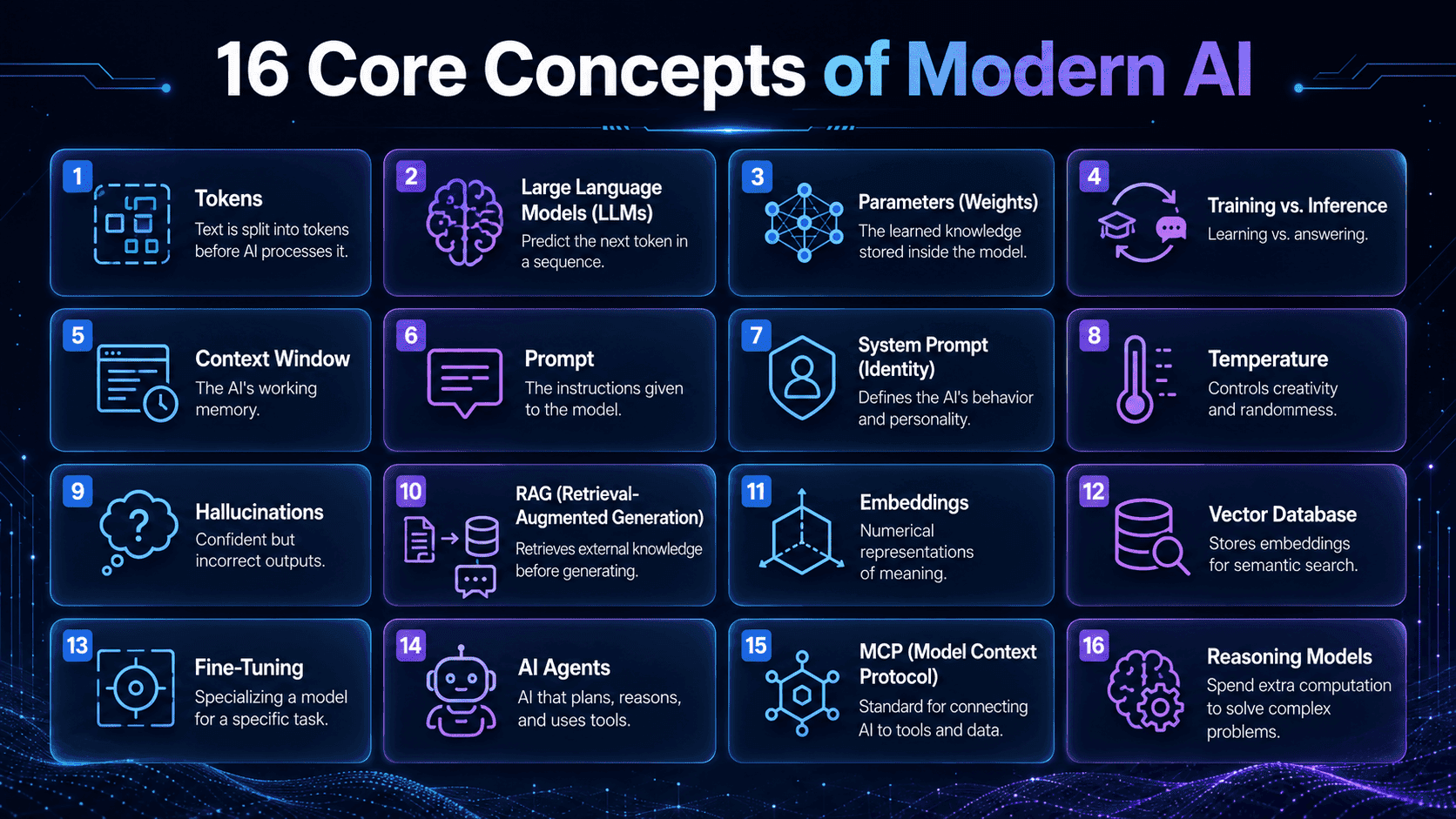
If you are using AI tools daily without understanding what's actually happening behind the prompt box.
The good news? You don't need a machine learning degree to close that gap.
A handful of these core concepts i am going to break down will explain you almost everything. Once they understand them, the rest of the field stops feeling like a black box.
Here's a clear walkthrough, grouped by what they actually do.
The Foundations
Tokens
Everything starts here.
AI models don't read words the way humans do. Before your prompt reaches the model, it gets broken into small pieces called tokens, and each token is converted into a number the model can actually process.
"I love cats" doesn't go in as three words. It becomes a handful of tokens, each represented as a numerical vector.
This matters because almost everything about using AI is measured in tokens:
- Context window size
- Your API pricing
- Your usage limits
- How much a model can "remember" etc...
Large Language Models (LLMs)
Strip away the hype and an LLM has exactly one job:
Predict the next token.
That's the entire mechanism.
Every response from ChatGPT, Claude, Gemini, or any other LLM comes from repeating that prediction one token at a time.
Parameters (Weights)
Parameters are the values a model learns during training.
Think of them as the model's internal numerical knowledge.
More parameters generally mean greater capacity to learn complex patterns, but a larger model isn't automatically a better one.
Training vs. Inference
These are two different phases that are easy to confuse.
Training
The model learns from massive datasets. This happens once (or periodically for new versions).
Inference
This is what happens every time you send a prompt.
The model applies what it learned during training to generate a response.
Working Memory & Control
Context Window
Think of this as the model's short-term memory.
It determines how much information the model can keep in mind during a conversation before older information falls out of view.
Prompt
A prompt is simply the instruction you give the model.
It sounds unremarkable, but it's often the single biggest factor affecting output quality.
System Prompt
A system prompt is a hidden set of instructions that defines the model's behavior, personality, and safety rules before your message is processed.
Temperature
Temperature controls how predictable or creative the model's responses are.
- Low temperature: More consistent and conservative.
- High temperature: More varied and creative.
Reliability
Hallucinations
Sometimes an AI model produces information that sounds completely confident but is incorrect.
This is known as a hallucination.
Always verify important facts, citations, code, and numerical results.
Extending What a Model Knows
RAG (Retrieval-Augmented Generation)
Instead of relying only on what it learned during training, a RAG system first retrieves relevant information from an external source.
The model then generates its answer using that retrieved context.
Embeddings
Embeddings convert text into numerical vectors that represent meaning rather than exact wording.
This is why models understand that car and vehicle are closely related concepts.
Vector Database
A vector database stores embeddings and quickly retrieves semantically similar ones.
It's the infrastructure that makes RAG practical.
Fine-Tuning
Fine-tuning continues training an existing model on specialized data so it performs better in a specific domain or task.
Beyond Simple Chat
AI Agents
An AI agent doesn't just answer questions.
It can:
- Plan
- Search the web
- Call APIs
- Use tools
- Write code
- Execute workflows
with minimal human intervention.
MCP (Model Context Protocol)
MCP is an open standard that allows AI models to securely connect with external tools and applications.
Think of it as a universal connector between AI and the rest of your software.
Reasoning Models
Reasoning models spend extra computation working through a problem before producing a final answer.
This makes them particularly strong at:
- Programming
- Mathematics
- Planning
- Logical reasoning
- Complex analysis
So, here the thing
None of these sixteen concepts require a technical background, they simply aren't explained very often in plain language.
Once they get to understand these concepts, most of what feels mysterious about modern AI starts making sense.
You start understanding not only how today's AI tools work, but also why they behave the way they do.